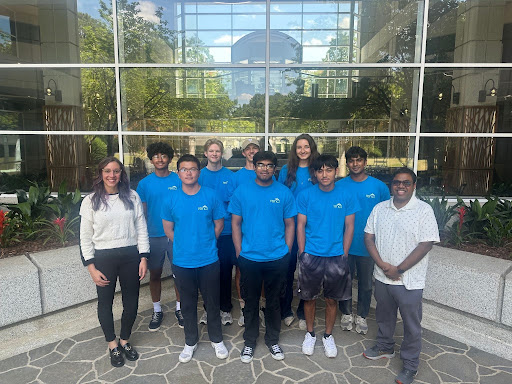
This summer, RENCI hosted eight students through the National Science Foundation's (NSF) Research Experience for Undergraduates (REU) program.
Over nine weeks, students immersed themselves in hands-on research experience at the intersection of advanced networking, distributed systems, machine learning, cybersecurity, and emerging cyberinfrastructure. Leveraging the NSF FABRIC research instrument, a nationwide testbed for advanced networking and systems research, students gained practical experience with a range of advanced technologies. These included in-band telemetry, P4- and FPGA-based networking, machine learning-driven cybersecurity, AI-assisted medical imaging, and federated learning. The program included research mentors from UNC-Chapel Hill, Illinois Institute of Technology, University of South Carolina, and Binghamton University, all faculty members with extensive expertise in conducting research with FABRIC.
“We are especially excited to host an REU site at RENCI for the first time,” said Anirban Mandal, director of the Network Research and Infrastructure Group (NRIG) at RENCI. “The program gives undergraduate students a unique opportunity to work alongside researchers, developers, and faculty mentors to tackle some of today’s most important challenges in networking, cybersecurity, artificial intelligence, and distributed systems.”
In addition to conducting research, students participated in professional development sessions focused on topics such as graduate school, careers in research, scientific communication, and networking. These experiences helped students build both technical expertise and the professional skills necessary for success in research and industry settings.
“I have gained a lot of skills, such as exposure to conducting research and the associated pipelining, as well as using the tools to do so,” said student Bryant Goseland. “I've also become much more comfortable with presenting and being in a more professional setting”
The REU program culminated in student presentations showcasing the innovative projects developed during the summer. The research addressed challenges ranging from improving network performance and security to advancing artificial intelligence applications and strengthening data-driven cyberinfrastructure. Through these projects, students contributed to emerging areas of discovery while gaining valuable experience in collaborative, interdisciplinary research.
“The program increased my interest in networking and systems by giving me a better understanding of the infrastructure and foundational concepts behind them,” said student Scarlett Francini. “It also helped me see how computer science and electrical engineering can support scientific discovery beyond traditional software or hardware applications. I now have a greater appreciation for the cyberinfrastructure that enables large scientific experiments and makes their data accessible and useful.”
By bringing together students from diverse academic backgrounds and institutions, the REU program at RENCI helped foster the next generation of researchers and innovators. The program also introduced a new group of emerging researchers to FABRIC and the broader cyberinfrastructure community.
“This inaugural cohort exceeded our expectations with the quality of their research and their enthusiasm for learning,” said Mandal. “We are proud of what they accomplished this summer and excited to see how they build on these experiences as the next generation of leaders in computing, networking, and data science.”
For more information about the NSF REU Site at RENCI visit https://reusite.renci.org/home/.