Published: August 14, 2026
What's new with FABRIC?
An update from Paul Ruth, FABRIC Principal Investigator
We are excited to announce that KNIT13: Networking for the Future will take place on September 28, 2026, in Washington, DC. This annual community event brings together researchers, educators, and innovators from across the FABRIC ecosystem for a day of learning, collaboration, and exploration of advanced research networking technologies.
Co-located with the PAWR PI Meeting, KNIT13 offers unique opportunities for cross-community engagement, featuring technical training, research presentations, and discussions on the future of programmable infrastructure. The Call for Talks is now open, and travel stipends are available to support broad participation from across the community.
Following KNIT13, the MERIF Workshop will be held at the same venue on September 29–30, 2026, creating an extended opportunity for networking, collaboration, and knowledge sharing.
We are also excited to announce that LoomAI Hub is now available at loomai.net. LoomAI is the new recommended way to use FABRIC, a browser-based interface for designing, deploying, and managing experiments with drag-and-drop topology building and a built-in AI assistant. Sign in with your FABRIC identity to launch your own environment. You can read more in our LoomAI forum and our PEARC26 paper.
In this newsletter, you'll find information about…
- KNIT13 Registration Open
- LoomAI Hub Is Now Available
- AI Infrastructure for Reproducible Experimentation on FABRIC | Stitching Together Innovations with FABRIC Users
- MERIF Workshop
- FABRIC News
- Opportunities to collaborate with the FABRIC team
KNIT13 Registration Open!
KNIT13: Networking for the Future brings together the FABRIC community for a day of advanced training, plenary sessions, and hands-on exploration of cutting-edge research networking. Taking place in Washington, DC, KNIT13 is co-located with the PAWR PI Meeting, creating an opportunity for cross-community engagement and collaboration. Combined meals will facilitate networking across projects and disciplines.
Date: September 28, 2026
Location: The George Washington University, Washington, DC
What to Expect:
- Advanced Training & Hands-On Learning: Dive deep into FABRIC's most powerful features and emerging capabilities with expert-led technical sessions.
- Thought-Provoking Plenary Sessions: Hear from visionaries shaping the future of programmable infrastructure and next-generation networking.
- Impactful Research Showcases: Explore real-world experiments spanning scientific domains, from high-energy physics to AI-driven network optimization, and see how FABRIC is accelerating discovery.
Note: The MERIF Workshop will follow KNIT13 and the PAWR PI Meeting and will be held at the same location in Washington, DC, September 29-30, 2026
AI Infrastructure for Reproducible Experimentation on FABRIC | Stitching Together Innovations with FABRIC Users
August 18, 2026 3:00-4:00 pm ET
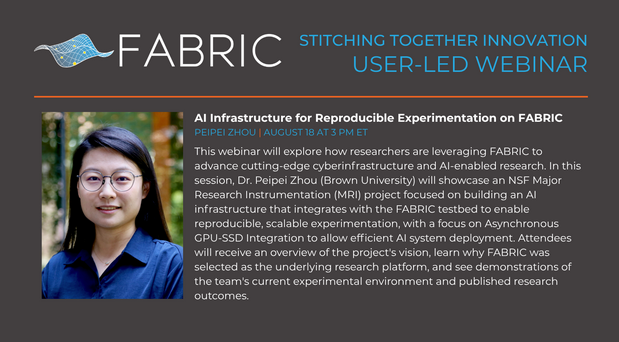
Join us for the next Stitching Together Innovation with FABRIC Users webinar as we explore how researchers are leveraging FABRIC to advance cutting-edge cyberinfrastructure and AI-enabled research. In this session, we'll hear from a team building AI infrastructure for reproducible experimentation on FABRIC, discussing their work to integrate GPUs, automated workflows, and scalable tools that make AI research more accessible and reproducible across the testbed.
The webinar will also provide an inside look at the project's future roadmap, including plans to connect a new multi-server AI research infrastructure to FABRIC, making it accessible to the broader research community for experimentation and discovery.
MERIF26 Workshop Registration Open!
The MERIF workshop will take place September 29–30, 2026, at The George Washington University in Washington, DC.
MERIF brings together NSF-supported research infrastructure providers and users to share best practices, reduce barriers to access, and strengthen cross-facility, reproducible research across the CISE community. We look forward to gathering the community in Washington, DC, for this important workshop supporting the future of midscale science.
To stay up to date on workshop logistics, registration information, and news, visit merif.org.
Registration Details
Registration is now open for MERIF 2026, taking place September 29-30, 2026, in Washington, DC. Register Here!
FABRIC News
LoomAI Hub Is Now Available at loomai.net
The new recommended way to use FABRIC
LoomAI Hub is live at loomai.net, and it is now the recommended way to use FABRIC. Sign in with your FABRIC identity to launch your own LoomAI environment right in your browser, with no local setup required.
LoomAI is our open-source, browser-based interface that replaces command-line and Jupyter notebook workflows with a visual, point-and-click experience. It brings drag-and-drop topology building, integrated management tools, an AI assistant for experiment design and troubleshooting, reusable Weaves, and the Artifact Marketplace together in one place. All AI features run on models hosted on FABRIC, so your work stays in a secure, research-focused environment.
If you have been working through the portal or Jupyter notebooks, now is a great time to move to LoomAI Hub. Go to loomai.net and sign in to get started.
Want more detail or have questions? The team has posted a full announcement in the new LoomAI forum on the FABRIC forum, where you can read more and connect with other users.
Thread the Needle: Preparing for the Post-Quantum Future with FABRIC
Researchers at the University of Illinois Urbana-Champaign are using FABRIC to develop PQSee, an open-source tool for measuring readiness for post-quantum cryptography, at a time when quantum computing threatens to break current encryption standards.
Thread the Needle: SENSE Unlocks New Possibilities by Connecting FABRIC and the National Research Platform
Researchers at the San Diego Supercomputer Center are using the Department of Energy's SENSE software to connect FABRIC and the National Research Platform (NRP) into a single distributed research environment, enabling seamless cross-platform experimentation.
Thread the Needle: Bringing an Open-Source 5G Core to the FABRIC Community
Researchers at the University of California, Riverside, the University of Kentucky, and National Yang Ming Chiao Tung University are developing an open-source, high-performance 5G core that will be offered as a service on FABRIC, making advanced cellular experimentation more accessible to the research community.
Educational Use: Using FABRIC for Class Projects
As a national research infrastructure for cutting-edge and exploratory research in networking, distributed computing, and science applications, FABRIC encourages faculty to use the infrastructure for teaching their classes. Training next-generation researchers to imagine and construct new computing and networking experiments at scale is an important goal for FABRIC. FABRIC has created sample experiments and Jupyter notebooks that are ready to be used by networking and systems classes for instructors.
These experiments include basic ping, network routing, exploring IPv6, TCP analysis, traffic generation, setting up a web server, using Ansible to manage a set of nodes, etc. They are available via GitHub as well as the FABRIC Artifact Manager. Of course, you can create your own assignments for students to do on the FABRIC infrastructure. The FABRIC team provides support from creating an education project, enrolling students, to answering questions from instructors and students. More information can be found here.
FABRIC Office Hours
Connect and troubleshoot with leadership and support
We have made a new office hours system available from the FABRIC portal that allows stakeholders to directly book time with the leadership team and technical team members to discuss anything from the feasibility of their experiments, to software questions, to experiment security, to connecting new facilities into FABRIC.
Book an appointment on our scheduling platform.
Defining FABRIC
A glossary for common terms used by our researchers
Cloud Resource – FABRIC allows access to several types of cloud resources, primarily Internet2-hosted cloud resources for which the user must pay from their own cloud account/budget, CloudBank-funded resources allocated to FABRIC, and Chameleon cloud resources.
See the full glossary on our website.
Solicitations
Funding opportunities that encourage the use of FABRIC
See a list of all solicitations mentioning FABRIC on our website.
Do you have a project idea that would benefit from using FABRIC? The FABRIC team welcomes requests for Letters of Collaboration. To expedite the process, please contact us by filling out the form.